
How to use this workbook
- Read the short explanation given for each section.
- Complete the practice questions in order.
- Check your reasoning using the ‘Why are we doing this?’ boxes.
- Use the reflective prompts to connect technique to judgement and purpose.
Introduction
Use this workbook alongside Units 7 and 8 of Principles of Accounting. The activities follow the flow of Unit 8:
Source documents → Journal entries → Ledger posting → Trial balance → Year-end adjustments → Preparation of Statement of Profit and Loss (SoPL) and Statement of Financial Position (SoFP) (Figure 8.1).
This workbook develops accounting as a system of structured reasoning.
You will move from transaction-level mechanics to financial statements, from performance measurement to equity movement, and from technical calculation to judgement and stewardship.
This workbook uses currency units (CU) throughout rather than specific currencies. This is aligned to the practices of the International Accounting Standards Board and ensures that the focus is on the principles rather than geography.
The goal is not simply to memorise accounting steps, but to understand how accounting works and why it matters. If you can explain the reasoning behind a journal entry or a financial statement, you will be better able to tackle unfamiliar problems with confidence, rather than relying only on memorised examples.
How to cite
Smith, S. and Rakeeb, F.R. (2026). From Transactions to Financial Statements: A Practical Accounting Workbook. Available at: https://accounting-streams.org/practical-accounting-workbooks/01-01.html
1 The accounting system
1.1 The accounting cycle
The accounting cycle diagram shown in Figure 1 demonstrates the process of accounting as both sequential and continuous.
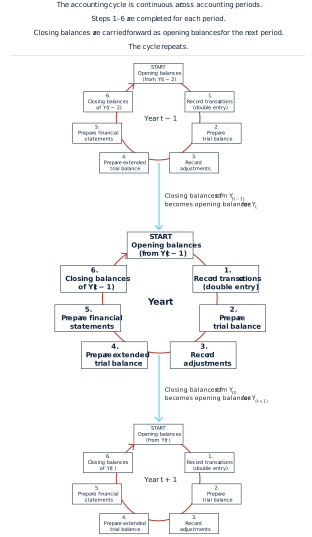
Figure 1 The accounting cycle.
Each accounting year (Y\((_t)\)) begins with opening balances brought down from the previous year’s (Y\(_{(t−1)}\)) closing balances, where applicable (that is, not in the first year of operations).
Step 1 records transactions using double entry.
Step 2 transfers these balances to the trial balance (see section 2).
Step 3 records year-end adjustments.
Step 4 reflects the impact of these adjustments in the adjusted trial balance.
Step 5 allows for financial statements to be prepared (see section 3).
Step 6 brings the closing balance at the end of the period down as the opening balance for the next accounting period (Y\(_{(t + 1)}\)) (see section 5).
This workbook takes you through the steps of the accounting cycle, providing guided practice to build skills and confidence.
1.2 The accounting equation
Debits and credits are explained as a logical system in Figure 8.4. This ensures that we maintain the accounting equation. As a reminder, some common transaction examples are outlined below.
| Transaction | Assets (CU) | Liabilities (CU) | Equity (CU) |
|---|---|---|---|
| Owner invests CU 80,000 | +80,000 cash |
+80,000 capital |
|
| Business pays rent CU 6,000 | −6,000 cash |
−6,000 (expense reduces equity) |
|
| Business borrows CU 100,000 | +100,000 cash |
+100,000 loan |
|
| Business purchases equipment CU 20,000 | +20,000 non-current assets −20,000 cash |
Figure 2 Illustrative transactions and their impact on the accounting equation
Principles of Accounting
1.3 From source documents to journal entries
Why are we doing this? Verifiability concept
Financial accounting relies on verifiable evidence. Source documents create an audit trail: someone should be able to trace a number in the accounts back to real-world evidence, for example an invoice, receipt, contract, or bank record. Beyond verifiability, three other qualities shape what makes financial information useful: understandability, timeliness, and comparability. Double-entry bookkeeping supports these qualities. Its standardised structure provides a consistent framework for recording transactions, making financial information easier to interpret. The systematic recording of transactions as they occur enables information to be summarised and reported promptly, and the consistent application of the same rules across periods and entities makes meaningful comparison possible.
Question 1
For each transaction, select the source document that provides the most appropriate evidence.
Question 1.1
Purchase inventory on credit.
Question 1.2
Provide services and receive cash.
Question 1.3
Pay monthly rent.
Question 1.4
Receive a bank loan.
Pause to reflect
- Which source documents are most reliable, and why?
- Who benefits from strong documentation? Consider owners, lenders, employees, tax authorities, and wider society.
2 Recording transactions (double entry)
See Unit 8 Section 8.5.
2.1 Guided practice on double entry
Why are we doing this? Duality concept
Double entry is a system for maintaining the accounting equation (Assets = Liabilities + Equity). Every transaction affects a business in two ways: if cash goes out, there is an impact, whether an asset acquisition, a reduction in a liability or an expense incurred. Double entry captures both sides of this exchange, helping to keep the accounting equation in balance and providing a complete and reliable record of the organisation’s activities.
Question 2
For the following transactions, select the accounts impacted.
An owner invests CU 8,000 cash into their business bank account.
Question 2.1
Debit:
Question 2.2
Credit:
The business makes a cash sale of services of CU 2,500.
Question 2.3
Debit:
Question 2.4
Credit:
The business pays a bill for insurance for Year 1 of CU 600.
Question 2.5
Debit:
Question 2.6
Credit:
The business purchases some supplies for CU 450 cash.
Question 2.7
Debit:
Question 2.8
Credit:
Pause to reflect
- Which transactions affect profit, cash, or both, and why?
- How would credit transactions change the entries?
2.2 Credit transactions and settlement
Why are we doing this? Accruals concept
Credit transactions separate the timing of economic activity from the timing of the associated cash flows. That separation is central to accrual accounting and explains why receivables and payables exist, enabling financial statements to provide useful information for decision-making.
Question 3
For the following credit and settlement transactions, select the accounts impacted.
Sell goods on credit for CU 1,750.
Question 3.1
Debit:
Question 3.2
Credit:
Receive CU 1,750 from customers later.
Question 3.3
Debit:
Question 3.4
Credit:
Purchase inventory on credit CU 3,200.
Question 3.5
Debit:
Question 3.6
Credit:
Settle the supplier account in full.
Question 3.7
Debit:
Question 3.8
Credit:
Pause to reflect
- How do receivables and payables affect risk and decision-making?
- What could go wrong if a business grows sales on credit too quickly?
- What information do users need to assess credit risk?
Mastering double entry can feel challenging. There are some excellent resources to help you with these fundamental accounting concepts, including:
Now attempt Practice Question 1 and Practice Question 2 in the Practice Questions section.
2.3 From journal to ledger to trial balance
See Unit 8 Section 8.6.
Why are we doing this? Duality concept
Groups of transactions are posted by account so that you can see the cumulative effects, for example, total revenue and total cash. The trial balance is an internal arithmetic check that the debits and credits are still balanced.
Once journal entries have been recorded, they can be transferred to T-accounts. T-accounts contain the same information as the journal entries but reorganise it by account, which makes it easier to see the cumulative effect of transactions on each account. Likewise, T-accounts can be translated back into journal entries, since both are simply different ways of representing the same underlying accounting information.
Worked example 1
Your friend has recently set up a business, and the following transactions took place in its first month. They have asked you to show them how to account for these transactions and ensure that everything balances in preparation for creating the accounts.
- The owner invests CU 20,000 cash into the business.
- The business purchases equipment for CU 6,000 cash.
- The business purchases inventory on credit for CU 2,000.
- The business makes cash sales of CU 3,500.
- The business pays CU 1,200 in rent in cash.
- The business pays CU 1,000 to suppliers in partial payment of the sum owed.
- The owner withdraws CU 800 cash for personal use.
Step 1: Establish the accounts impacted.
Step 2: Create the T-accounts.
Step 3: Transfer the balances to the trial balance.
Click through the accompanying slides that work through the example step by step and give the solutions.
Just because the trial balance balances does not mean it is correct. Several types of error may occur in the preparation of the trial balance. They are outlined in Figure 3.
| Error type | What happens | Impact on trial balance |
| Transposition error | Digits reversed (for example, 64 instead of 46) | Usually does not balance |
| Omission error | Transaction left out completely or partially | Completely: balances Partially: does not balance |
| Compensating error | Two errors cancel each other | Balances |
| Error of principle | Wrong type of account used | Balances |
Figure 3 Types of error that may occur in preparation of a trial balance.
2.4 Practice questions
Attempt Practice Questions 3 to 6 in the Practice Questions section.
These four introductory trial balance practice questions are designed to help you apply the concepts involved in preparing a trial balance. They build skills progressively.
3 Year-end adjustments (with calculations)
See Unit 8 Section 8.7 (Year-end adjustments).
Why are we doing this? Accruals concept
Adjustments are about faithful representation under accrual accounting: they recognise what has been earned or incurred, even if cash hasn’t moved, and ensure assets and liabilities are not misstated.
3.1 Depreciation (non-cash charge)
See Unit 8 Section 8.5.12 (Depreciation of non-current asset).
Depreciation is a non-cash charge that spreads the cost of non-current assets over their estimated useful economic lives. It is normally recorded as a year-end adjustment to the accounts:
Different methods of deprecation are outlined in Unit 7.
Debit: Depreciation expense (SoPL)
Credit: Accumulated depreciation (SoFP)
3.2 Accruals (expense incurred, not yet paid)
See Unit 8 Section 8.7.1 (Accruals).
Worked example 2
Wages of CU 1,200 relate to this period but are unpaid at year-end.
- Identify the amount relating to the current period: 1,200.
- Recognise the expense now (matching the period).
- Recognise a liability because the business owes this amount at year-end.
Record the adjustment:
Debit: Wages expense 1,200
Credit: Wages payable (accrued expenses) 1,200
Pause to reflect
- Who is affected if wages are not accrued? Consider employees, managers, and investors.
- How does this adjustment change profit and liabilities?
3.3 Prepayments (cash paid, expense belongs to the future)
See Unit 8 Section 8.7.2 (Prepayments).
Worked example 3
Rent of CU 900 has been paid in advance and relates to the next period.
- Identify the amount that relates to a future period: 900.
- Remove it from this period’s expenses.
- Recognise an asset (prepaid rent) because it represents a future benefit.
Record the adjustment:
Debit: Prepaid rent 900
Credit: Rent expense 900
Pause to reflect
- Why is a prepayment an asset?
- How could aggressive prepayment adjustments be used to inflate profit?
3.4 Inventory and cost of sales
See Unit 8 Section 8.5.5 (Credit purchase of inventory).
This workbook uses the periodic inventory method unless stated otherwise. Purchases are recorded in a purchases account during the year, and cost of sales is calculated at year-end.
Inventory connects the SoFP (asset) with the SoPL (expense). The change in inventory determines the amount of inventory consumed in earning revenue.
Cost of sales formula:
Opening inventory + Purchases – Closing inventory = Cost of sales
Worked example 4
| Opening inventory | 3,000 |
| + Purchases | 7,000 |
| − Closing inventory | (2,500) |
| = Cost of sales | 7,500 |
Figure 4 shows how inventory connects the SoPL and the SoFP. The closing inventory of CU 30,000 reported in the SoPL is the same amount reported as inventory under current assets in the SoFP.
| Alpha Ltd Statement of Profit and Loss for the year ended 31 Dec 20x5 |
Alpha Ltd Statement of Financial Position as at 31 Dec 20x5 |
||||
| CU | CU | ||||
| Non-current assets | |||||
| Sales | 180,000 | Shop equipment | 22,500 | ||
| Cost of goods sold: | Less: Accumulated depreciation | (4,500) | |||
| Opening inventory | 22,500 | Net book value | 18,000 | ||
| Purchases | 105,000 | ||||
| Closing inventory | 30,000 | (97,500) | Current assets | ||
| Gross profit | 82,500 | Cash | 135,000 | ||
| Operating expenses: | Accounts receivable | 40,500 | |||
| Wages expense | 45,000 | Inventory | 30,000 | ||
| Rent expense | 18,000 | 205,500 | |||
| Bad debt expense | 4,500 | Total assets | 223,500 | ||
| Depreciation expense | 4,500 | ||||
| Warranty expense | 3,000 | (75,000) | Equity and liabilities | ||
| Operating profit | 7,500 | Capital | 153,000 | ||
| Interest | (1,500) | Less: Loss for the year | (3,000) | ||
| Profit after interest | 6,000 | 150,000 | |||
| Tax | (9,000) | ||||
| Retained profit | (3,000) | Non-current liabilities | |||
| Bank loan | 30,000 | ||||
| Current liabilities | |||||
| Accounts payable | 30,000 | ||||
| Interest payable | 1,500 | ||||
| Tax payable | 9,000 | ||||
| Provision for warranty | 3,000 | ||||
| 43,500 | |||||
| Total equity and liabilities | 223,500 | ||||
Figure 4 Extracts from Statement of Profit and Loss for the year ended 31 December 20x5 and the Statement of Financial Position as at 31 December 20x5.
Principles of Accounting
3.5 Inventory write-down to net realisable value (NRV)
See Unit 7 Section 7.4.7 (Measuring current assets).
Inventory must be valued at the lower of cost and net realisable value (NRV).
Why are we doing this? Prudence concept
This is an example of the prudence concept: inventory should not be overstated, because the accounts should reflect economic reality rather than optimism. If the cost cannot be recovered through selling or using the inventory, the loss should be recognised now.
Worked example 5
The closing inventory has a cost of CU 5,000 and an NRV of CU 4,300. Determine and record the required inventory write-down adjustment.
Step-by-step calculation:
- Determine the carrying amount at cost: 5,000.
- Determine the NRV (expected selling price less cost to sell): 4,300.
- Compare: inventory must be stated at the lower of cost and NRV.
- Calculate the required write-down: 5,000 − 4,300 = 700.
Record the adjustment:
Debit: Inventory write-down expense (or cost of sales) 700
Credit: Inventory (or allowance for inventory write-down) 700
Pause to reflect
- Why might managers resist write-downs?
- What evidence supports NRV?
3.6 Specific bad debt (confirmed irrecoverable)
See Unit 8 Section 8.7.3 (Bad debt).
Why are we doing this? Faithful representation concept
Assets should reflect realisable value, which means that uncollectible amounts should be removed from accounts receivable. If we know that some customers will not pay, those losses should be recognised immediately. Otherwise, receivables would be overstated, and profit would include amounts that are unlikely to be collected.
Worked example 6
A customer owing CU 150 has gone into liquidation. As a result, the CU 150 is irrecoverable (will never be received).
Step-by-step calculation:
- Identify the specific receivable that is expected to be irrecoverable: 150.
- Recognise the expense (loss) in the period identified.
- Remove this from the accounts receivable balance.
Record the adjustment:
Debit: Bad debt expense 150
Credit: Accounts receivable 150
Pause to reflect
- Which signals indicate a bad debt?
- How might increasing bad debts affect credit policy?
3.7 Expected credit losses (loss allowance)
See Unit 8 Section 8.7.3 (Bad debt).
Why are we doing this? Prudence concept
Expected credit losses reflect estimated losses on receivables before they are confirmed. If a business knows from past experience that some customers are unlikely to pay, those expected credit losses should be recognised now. Otherwise, receivables may be overstated, and profit may include amounts that are unlikely to be collected. This is also sometimes referred to as an allowance doubtful debts.
Worked example 7
Accounts receivable total CU 10,000. You estimate that 5% of this total will be uncollectible.
- Identify the receivables balance to assess: 10,000.
- Apply the expected percentage: 5%.
- Calculate the expected credit losses: 10,000 × 5% = 500.
Record the adjustment:
Debit: Expected credit loss expense 500
Credit: Loss allowance 500
Pause to reflect
- What is the difference between specific write-offs and expected credit losses?
- What assumptions are embedded in the 5% estimate?
- How could estimates be manipulated?
Where an existing allowance exists, any adjustment must be accounted for as follows:
Adjustment = required closing allowance – existing allowance
3.8 Provisions (uncertain liabilities)
See Unit 8 Section 8.7.4 (Provision).
Why are we doing this? Matching concept
Provisions help ensure that liabilities are not hidden and that profit does not appear healthier than it really is. They introduce judgement and estimation into accounting because they deal with obligations for which timing or amount is uncertain. As they involve uncertain future events, provisions also reflect the prudence concept.
Worked example 8
A legal claim raised by a customer, estimated at CU 20,000, is likely to be lost by the company. Record the adjustment:
Debit: Legal expense 20,000
Credit: Provision for legal claim 20,000
Pause to reflect
- Why are provisions open to manipulation?
- Who might challenge these estimates?
Worked example 9
Complete the full cycle: journal entries → ledger → trial balance → adjustments → brief statements.
Transactions
- Owner invests CU 10,000 cash.
- Business buys inventory CU 3,000 cash.
- Business made credit sales CU 4,000.
- Business pays wages of CU 1,200.
Adjustments
- An amount of CU 300 is accrued for utilities.
- Closing inventory is CU 1,000.
- Some damaged inventory is identified, and an inventory write-down of CU 200 is recognised.
- Create a 5% allowance for expected credit losses on remaining receivables.
Step 1: Record the transactions in the T-accounts.
Remember that T-accounts and journal entries contain the same information, so you may find it helpful to first write the journal entry and then post it to the T-accounts.
| Cash account | |||
| Debit | Credit | ||
| 1. Capital | 10,000 | 2. Purchases | 3,000 |
| 4. Wages | 1,200 | ||
| Balance c/down | 5,800 | ||
| Total | 6,000 | Total | 6,000 |
| Balance b/down | 5,800 | ||
| Purchases account | |||
| Debit | Credit | ||
| 2. Cash | 3,000 | ||
| SoPL | 3,000 | ||
| Total | 3,000 | Total | 3,000 |
| Capital account | |||
| Debit | Credit | ||
| 1. Cash | 10,000 | ||
| Balance c/down | 10,000 | ||
| Total | 10,000 | Total | 10,000 |
| Balance b/down | 10,000 | ||
| Sales account | |||
| Debit | Credit | ||
| 3. Accounts receivable | 4,000 | ||
| SoPL | 4,000 | ||
| Total | 4,000 | Total | 4,000 |
| Accounts receivable account | |||
| Debit | Credit | ||
| 3. Sales | 4,000 | ||
| Balance c/down | 4,000 | ||
| Total | 4,000 | Total | 4,000 |
| Balance b/down | 4,000 | ||
| Wages account | |||
| Debit | Credit | ||
| 4. Cash | 1,200 | ||
| SoPL | 1,200 | ||
| Total | 1,200 | Total | 1,200 |
Step 2: Draw up the trial balance.
| Account | Debit (CU) | Credit (CU) |
| Cash | 5,800 | |
| Capital | 10,000 | |
| Purchases | 3,000 | |
| Sales | 4,000 | |
| Accounts receivable | 4,000 | |
| Wages expense | 1,200 | |
| Total | 14,000 | 14,000 |
Step 3: Include the adjustments.
| Trial balance | Adjustments | Adjusted trial balance | ||||
| Account | Debit (CU) | Credit (CU) | Debit (CU) | Credit (CU) | Debit (CU) | Credit (CU) |
| Cash | 5,800 | 5,800 | ||||
| Capital | 10,000 | 10,000 | ||||
| Purchases | 3,000 | 3,000 | ||||
| Sales | 4,000 | 4,000 | ||||
| Accounts receivable | 4,000 | 4,000 | ||||
| Wage expense | 1,200 | 1,200 | ||||
| Utilities expense | 300 | 300 | ||||
| Accrued utilities | 300 | 300 | ||||
| Year-end inventory (SoFP) | 1,000 | 1,000 | ||||
| Year-end inventory (SoPL) | 1,000 | 1,000 | ||||
| Inventory write-down (SoFP) | 200 | 200 | ||||
| Expected credit loss expense (SoPL) | 200 | 200 | ||||
| Loss allowance (SoFP) | 200 | 200 | ||||
| Total | 14,000 | 14,000 | 1,700 | 1,700 | 15,700 | 15,700 |
Step 4: Prepare the statements.
| Statement of Profit and Loss for the year ending 31 March 20x6 | ||
| CU | ||
| Revenue less cost of sales: | 4,000 | |
| Purchases | 3,000 | |
| Closing inventory | (1,000) | (2,000) |
| Gross profit | 2,000 | |
| Expenses: | ||
| Wages | 1,200 | |
| Utilities | 300 | |
| Inventory write-down | 200 | |
| Expected credit loss | 200 | (1,900) |
| Operating profit | 100 | |
| Interest | 0 | |
| Profit after interest | 100 | |
| Tax | − | |
| Profit for the year | 100 | |
| Statement of Financial Position as at 31 March 20x6 | ||
| CU | ||
| Current assets | ||
| Inventory | 800 | |
| Accounts receivable | 4,000 | |
| Loss allowance | (200) | 3,800 |
| Cash | 5,800 | |
| Total current assets | 10,400 | |
| Total assets | 10,400 | |
| Equity and liabilities | ||
| Capital | 10,100 | |
| Current liabilities | ||
| Accrued utilities | 300 | |
| Total current liabilities | 300 | |
| Total equity and liabilities | 10,400 | |
Pause to reflect
- Which numbers in the worked example are the most judgement-based?
- Who might challenge your estimates? For example, auditors, lenders, regulators, and others.
3.9 Practice questions
Attempt Practice Questions 7 to 10 in the Practice Questions section.
The four practice questions for this section help to build your skills in applying adjustments to the trial balance.
4 Performance, equity and distribution
This section explains what happens after the Statement of Profit and Loss has been prepared:
- Profit is transferred into equity.
- Equity may then be distributed (drawings or dividends).
- The remainder is retained in the business.
Why are we doing this? Stewardship and decision-making
Users of financial statements need to understand:
- how much profit was generated
- how much was retained versus distributed.
This helps in assessing:
- sustainability
- reinvestment
- returns to owners.
4.1 Retained earnings and appropriation of profit
See Unit 7 Section 7.4.9 (Measuring equity).
Revenue and expense accounts reset each year because they measure performance for a defined period. Retained earnings accumulate performance across years.
Here is an example of retained earnings movement.
| CU | |
|---|---|
| Opening retained earnings | 12,000 |
| Add: Profit for the year | 4,500 |
| Less: Dividends declared | (1,000) |
| Closing retained earnings | 15,500 |
4.2 Drawings (sole trader)
Drawings represent distributions to the owner, not business expenses. They reduce equity directly and must not be confused with expenses, which reduce profit.
Worked example 10
The owner withdraws CU 1,000 cash for personal use.
Double entry:
Debit: Drawings 1,000
Credit: Cash 1,000
At year-end, drawings are closed to capital (sole trader):
Debit: Capital 1,000
Credit: Drawings 1,000
This reduces the owner’s equity but does not affect profit.
Question 4
The owner withdraws inventory worth CU 300 for personal use. What are the entries at the point of withdrawal?
Question 4.1
Debit:
Question 4.2
Credit:
Which entries are required at year-end?
Question 4.3
Debit:
Question 4.4
Credit:
Important distinction: Expenses reduce profit. Drawings reduce equity directly. Confusing the two overstates expenses and understates performance.
4.3 Dividends (companies)
Worked example 11
Step 1: Declare the dividend.
The company declares a dividend of CU 5,000.
Double entry at declaration:
Debit: Retained earnings 5,000
Credit: Dividends payable 5,000
Step 2: Pay the dividend.
When the dividend is paid:
Debit: Dividends payable 5,000
Credit: Cash 5,000
Question 5
A dividend of CU 2,500 is declared and will be paid later. Select the accounts impacted.
On declaration:
Question 5.1
Debit:
Question 5.2
Credit:
On payment:
Question 5.3
Debit:
Question 5.4
Credit:
4.4 Comparison: Drawings versus dividends
| Feature | Drawings | Dividends |
|---|---|---|
| Business type | Sole trader | Company |
| Account affected | Capital | Retained earnings |
| Affect profit? | No | No |
| Affect equity? | Yes | Yes |
Pause to reflect
- Why are dividend rules stricter than drawings?
- How does this relate to protecting investors?
4.5 Practice questions
Now attempt Practice Question 11 and Practice Question 12 in the Practice Questions section.
5 Balances brought forward (Year 2 and beyond)
Why are we doing this? Going concern
Accounting is cumulative. Year 1 closing balances automatically become Year 2 opening balances, preserving continuity and allowing performance to be measured across periods. This also reflects the going concern assumption that the business will continue operating for the foreseeable future, rather than being liquidated at year-end.
5.1 Recording transaction in Year 2
The following worked example shows how transactions are recorded in Year 2, from understanding the opening SoFP balances to closing the accounts at the end of the year.
Worked example 12
Step 1: Understand the opening SoFP.
Opening balances on 1 January Year 2:
| Non-current assets | CU |
| Equipment | 10,000 |
| Current assets | |
| Inventory | 3,000 |
| Accounts receivable | 2,000 |
| Cash | 5,000 |
| Total current assets | 10,000 |
| Total assets | 20,000 |
| Liabilities and equity | |
| Capital | 18,500 |
| Accounts payable | 1,500 |
| Total liabilities and equity | 20,000 |
Pause to reflect
- Can you explain why the opening SoFP must balance before recording any transactions?
- Can you describe what could cause an imbalance in the opening figures?
Step 2: Enter the opening balances into the ledger.
Opening balances are entered on the debit or credit side depending on their normal balance:
| Assets | Debit |
| Liabilities | Credit |
| Equity | Credit |
This represents the opening assets available at the start of the year.
One important example of an opening balance is inventory. The following example illustrates how balances are carried down from the previous year.
Inventory across years:
Year 1 closing inventory: CU 3,000
This becomes Year 2 opening inventory (asset).
If Year 2’s closing inventory is CU 2,500, then the reduction affects the cost of sales in Year 2.
Inventory movement = opening 3,000 – closing 2,500 = CU 500 reduction.
Why are we doing this? Matching concept
Opening inventory represents goods available at the start of the period. The change between opening and closing inventory determines how much inventory was consumed in generating revenue.
Pause to reflect
- Why does opening inventory affect the cost of sales?
- What risks arise if opening balances are incorrect?
Step 3: Record Year 2 transactions normally.
Once balances are brought forward, Year 2 transactions are recorded exactly as before. The opening balances simply form the starting totals in each ledger.
Example transaction: Sell goods on credit for CU 1,200 in Year 2.
| Accounts receivable account | ||||
| Debit | Credit | |||
| Year 1 b/down | 2,000 | |||
| Revenue | 1,200 | |||
| Year 1 c/down | 3,200 | |||
| Total | 3,200 | Total | 3,200 | |
| Year 2 b/down | 3,200 | |||
Pause to reflect
- How is credit risk changed by starting with receivables that are already outstanding?
- Why is it important to distinguish between opening balances and current year activity?
- What does a credit balance in a cash account indicate?
Step 4: Close Year 2.
At the end of Year 2:
- Prepare the trial balance.
- Record the adjustments (accruals, prepayments, inventory write-downs, and provisions).
- Prepare the financial statements.
The closing balances become Year 3’s opening balances.
Key principle: The closing balance carried down becomes the opening balance brought down in the next period.
Worked example 13
Nexa Retail Ltd is a small retail business that completed its first year of trading on 31 December Year 1. The SoFP at that date is shown below.
| Nexa Retail Ltd | |
| Statement of Financial Position 31 December Year 1 | |
| Non-current assets | CU |
| Equipment | 42,000 |
| Less: Accumulated depreciation | (8,750) |
| 33,250 | |
| Total current assets | |
| Inventory | 10,500 |
| Accounts receivable | 7,000 |
| Prepaid rent | 3,500 |
| Cash | 17,500 |
| 38,500 | |
| Total assets | 71,750 |
| Total equity and liabilities | |
| Share capital | 64,750 |
| Retained earnings | (1,750) |
| 63,000 | |
| Non-current liabilities | − |
| Total current liabilities | |
| Accounts payable | 5,250 |
| Wages payable | 3,500 |
| 8,750 | |
| Total equity and liabilities | 71,750 |
Year 2 transactions:
During the year ended 31 December Year 2, the following transactions took place:
- The company made credit sales of CU 63,000.
- Cash sales amounted to CU 10,500.
- Cash received from credit customers was CU 56,000.
- Inventory was purchased on credit for CU 38,500.
- Payments to credit suppliers amounted to CU 35,000.
- Rent paid during the year was CU 14,000.
- Wages paid during the year amounted to CU 21,000.
Adjustments at 31 December Year 2:
- Closing inventory was CU 14,000.
- Rent prepaid at year-end was CU 4,200.
- Wages accrued at year-end were CU 2,800.
- Depreciation on equipment for the year was CU 8,750.
Required
- Enter the opening balances of Year 2 into the relevant ledger accounts (Step 2 of Worked example 12).
- Record the Year 2 transactions (Step 3 of Worked example 12).
- Prepare the trial balance including opening balances and Year 2 activity (Step 4.1 of Worked example 12).
- Record adjustments at end of Year 2 (Step 4.2 of Worked example 12).
Solutions
- Click through the slide deck to see the opening balances recorded in the ledger accounts.
- Click through the slide deck to see the Year 2 transactions recorded.
- Trial balance:
| Nexa Retail Ltd Trial Balance at the end of Year 2 | ||
| Account | Debit (CU) | Credit (CU) |
| Equipment | 42,000 | |
| Accumulated depreciation (SoFP) | 8,750 | |
| Inventory | 10,500 | |
| Accounts receivable | 14,000 | |
| Prepaid rent | 3,500 | |
| Cash | 14,000 | |
| Share capital | 64,750 | |
| Retained earnings / Accumulated losses | 1,750 | |
| Accounts payable | 8,750 | |
| Wages payable | 3,500 | |
| Sales | 73,500 | |
| Purchases | 38,500 | |
| Rent expense | 14,000 | |
| Wages | 21,000 | |
| Total | 159,250 | 159,250 |
- Adjustments at end of Year 2:
| Adjustment to rent | |
|---|---|
| Rent paid during the year | 14,000 |
| Add: opening prepaid rent | 3,500 |
| Less: rent prepaid at end of Year 2 (SoFP) | (4,200) |
| Rent expense for Year 2 (SoPL) | 13,300 |
So, rent expense must be reduced by 700.
| Adjustment to wages | |
|---|---|
| Wages paid during the year | 21,000 |
| Add: wages payable at end of Year 2 (SoFP) | 2,800 |
| Less: opening wages payable balance | (3,500) |
| Wages for Year 2 (SoPL) | 20,300 |
So, wages expense must be reduced by 700.
| Trial balance | Adjustments | Adjusted trial balance | ||||
| Account | Debit (CU) | Credit (CU) | Debit (CU) | Credit (CU) | Debit (CU) | Credit (CU) |
| Equipment | 42,000 | 42,000 | ||||
| Accumulated depreciation (SoFP) | 8,750 | 8,750 | 17,500 | |||
| Opening inventory | 10,500 | 10,500 | ||||
| Accounts receivable | 14,000 | 14,000 | ||||
| Prepaid rent | 3,500 | 700 | 4,200 | |||
| Cash | 14,000 | 14,000 | ||||
| Share capital | 64,750 | 64,750 | ||||
| Retained earnings | 1,750 | 1,750 | ||||
| Accounts payable | 8,750 | 8,750 | ||||
| Wages payable | 3,500 | 700 | 2,800 | |||
| Sales | 73,500 | 73,500 | ||||
| Purchases | 38,500 | 38,500 | ||||
| Rent expense | 14,000 | 700 | 13,300 | |||
| Wages | 21,000 | 700 | 20,300 | |||
| Depreciation expense | 8,750 | 8,750 | ||||
| Closing Inventory (SoFP) | 14,000 | 14,000 | ||||
| Closing Inventory (CoS) | 14,000 | 14,000 | ||||
| Total | 159,250 | 159,250 | 24,150 | 24,150 | 181,300 | 181,300 |
Question 6
Using the solutions for Worked example 13, prepare the SoPL and the closing SoFP for the end of Year 2 for Nexa Retail Ltd. (This is Step 4.3 of Worked example 12.)
Answer
To see the answer for Question 6, download the PDF of Nexa Retail Ltd’s SoPL and closing SoFP.
5.2 Common mistakes with opening balances
Some of the mistakes that can occur when opening balances are brought down from the previous year include the following:
- Re-recording opening balances as new transactions
- Forgetting that revenue and expenses do NOT have opening balances
- Mixing up retained earnings within capital
Important note: Revenue and expense accounts start at zero in each new period. Only asset, liability, and equity balances are brought forward.
Pause to reflect
- Why do revenue and expense accounts reset each year?
- How does this relate to measuring annual performance?
5.3 Practice questions
Question 7
Orion Furnishings provides the following extracts from its financial statements for Year 1 and Year 2.
| Statement of Profit and Loss (extract) | ||
| Year 1 (CU) | Year 2 (CU) | |
| Sales | 24,000 | 26,000 |
| Cost of sales | (11,000) | (600) |
| Gross profit | 13,000 | 25,400 |
| Statement of Financial Position (extract) | ||
| Year 1 (CU) | Year 2 (CU) | |
| Inventory | 4,200 | 3,600 |
Additional information
- No inventory was purchased during Year 2.
Question 7.1
What is the opening inventory for Year 2?
- This is the closing inventory for Year 2, not the opening balance.
- Opening inventory for Year 2 is the closing inventory from Year 1, which is CU 4,200.
- This represents the inventory movement, which is a reduction from CU 4,200 to CU 3,600 during Year 2. This is not the opening balance.
- This is the cost of sales for Year 1, which is an SoPL item and not carried forward as an opening balance.
Question 7.2
What is the impact of inventory movement on cost of sales in Year 2?
- The reduction in inventory from CU 4,200 to CU 3,600 represents inventory consumed during the year, which increases cost of sales.
- Incorrect direction. Although the amount CU 600 is correct, a decrease in inventory will increase cost of sales, not decrease it.
- Incorrect amount. This likely arises from incorrectly adding opening and closing inventory instead of calculating the difference.
- This likely arises from incorrectly adding opening and closing inventory instead of calculating the difference, as well as assuming that a change in inventory always reduces cost of sales.
Question 7.3
Which of the following balances will be carried forward from Year 2 to Year 3 as an opening balance?
- Sales is a SoPL item and relates only to Year 2 performance. This account resets at the beginning of each accounting year and is not carried forward.
- Cost of sales is an expense and like all expenses it is not carried forward. This account resets at the beginning of each accounting year.
- Inventory is an asset and an SoFP item. The closing balance at the end of Year 2 becomes the opening balance for Year 3.
- Gross profit is a summary SoPL figure and not a balance carried forward. Although it contributes to retained earnings (which is an SoFP item and carried forward), it is not itself carried forward as an opening balance.
6 Integrated practice
In this section, you will put together all the skills that you have learned.
Question 8
Bonjour Boulangerie is an artisan bakery operating in Paris. You have recently set up an accounting practice in the city and have been asked to prepare the business’s Year 2 accounts.
Opening statement of financial position for Bonjour Boulangerie as at 1 January Year 2:
| CU | |
| Non-current assets | |
| Equipment | 10,000 |
| Current assets | |
| Inventory | 3,000 |
| Accounts receivable | 2,000 |
| Cash | 5,000 |
| Total current assets | 10,000 |
| Total assets | 20,000 |
| Total equity and liabilities | |
| Share capital | 3,500 |
| Retained earnings | 15,000 |
| Current liabilities | |
| Accounts payable | 1,500 |
| Total equity and liabilities | 20,000 |
Transactions during Year 2:
- The business made credit sales to trade customers of 6,000.
- The business carried out cash purchases of 2,500.
- Wages of 1,200 were paid.
- The business received 3,000 from customers.
Adjustments at the end of Year 2:
- Inventory at year-end was 2,800.
- The finance director wants to create an allowance for expected credit losses of 5% on closing receivables.
- Management declared a dividend of 1,000.
- Depreciation of 500 was charged on the equipment.
Required
Record the transactions in the T-accounts, create the trial balance and then draw up the SoFP and SoPL for the year.
Answer
T-accounts
| Sales account | |||
|---|---|---|---|
| Debit | Credit | ||
| 1. Accounts receivable | 6,000 | ||
| SoPL | 6,000 | ||
| Total | 6,000 | Total | 6,000 |
| Accounts receivable account | |||
| Debit | Credit | ||
| b/down | 2,000 | ||
| 1. Credit sales | 6,000 | 4. Cash | 3,000 |
| Balance c/down | 5,000 | ||
| Total | 8,000 | Total | 8,000 |
| Balance b/down | 5,000 | ||
| Cash account | |||
| Debit | Credit | ||
| b/down | 5,000 | 2. Purchases | 2,500 |
| 4. Accounts receivable | 3,000 | 3. Wages | 1,200 |
| Balance c/down | 4,300 | ||
| Total | 8,000 | 8,000 | |
| Balance b/down | 4,300 | ||
| Wages account | |||
| Debit | Credit | ||
| 3. Cash | 1,200 | ||
| SoPL | 1,200 | ||
| Total | 1,200 | Total | 1,200 |
| Purchases account | |||
| Debit | Credit | ||
| 2. Cash | 2,500 | ||
| SoPL | 2,500 | ||
| Total | 2,500 | Total | 2,500 |
Trial balance
| Bonjour Boulangerie trial balance at the end of Year 2 | ||
| Account | Debit (CU) | Credit (CU) |
| Equipment | 10,000 | |
| Inventory | 3,000 | |
| Accounts receivable | 5,000 | |
| Cash | 4,300 | |
| Equity | 3,500 | |
| Retained earnings | 15,000 | |
| Accounts payable | 1,500 | |
| Sales | 6,000 | |
| Wages | 1,200 | |
| Purchases | 2,500 | |
| Totals | 26,000 | 26,000 |
Adjusted trial balance
| Trial balance | Adjustments | Adjusted trial balance | ||||
| Account | Debit (CU) | Credit (CU) | Debit (CU) | Credit (CU) | Debit (CU) | Credit (CU) |
| Equipment | 10,000 | 500 | 9,500 | |||
| Inventory | 3,000 | 3,000 | ||||
| Accounts receivable | 5,000 | 5,000 | ||||
| Cash | 4,300 | 4,300 | ||||
| Equity | 3,500 | 3,500 | ||||
| Retained earnings | 15,000 | 1,000 | 14,000 | |||
| Accounts payable | 1,500 | 1,500 | ||||
| Sales | 6,000 | 6,000 | ||||
| Wages | 1,200 | 1,200 | ||||
| Purchases | 2,500 | 2,500 | ||||
| Inventory at year-end (SoFP) | 2,800 | 2,800 | ||||
| Inventory at year-end (CoS) | 2,800 | 2,800 | ||||
| Expected credit loss (SoPL) | 250 | 250 | ||||
| Loss allowance (SoFP) | 250 | 250 | ||||
| Dividend payable | 1,000 | 1,000 | ||||
| Depreciation (SoPL) | 500 | 500 | ||||
| Totals | 26,000 | 26,000 | 4,550 | 4,550 | 29,050 | 29,050 |
Financial statements
| Statement of Profit and Loss for Bonjour Boulangerie for Year 2 | ||
| CU | ||
| Revenue less cost of sales | 6,000 | |
| Opening inventory | 3,000 | |
| Purchases | 2,500 | |
| Closing inventory | (2,800) | (2,700) |
| Gross profit | 3,300 | |
| Operating expenses | ||
| Wages | (1,200) | |
| Expected credit loss | (250) | |
| Depreciation | (500) | |
| Profit for the year | 1,350 | |
| Statement of Financial Position for Bonjour Boulangerie as at end of Year 2 | ||
| CU | ||
| Non-current assets | ||
| Equipment | 9,500 | |
| Current assets | ||
| Inventory | 2,800 | |
| Accounts receivable | 5,000 | |
| Loss allowance | (250) | |
| Cash | 4,300 | |
| Total current assets | 11,850 | |
| Total assets | 21,350 | |
| Total equity and liabilities | ||
| Equity | 3,500 | |
| Retained earnings | 15,350 | |
| Current liabilities | ||
| Accounts payable | 1,500 | |
| Dividend payable | 1,000 | |
| Total current liabilities | 2,500 | |
| Total equity and liabilities | 21,350 | |
Find additional practice questions in the next section.
Pause to reflect
Where are the main areas in which judgement is required? How do dividend decisions affect long-term sustainability?
